Planning a cruise should feel like the start of a vacation, but it can often feel more like solving a complex puzzle. Between picking the right ship, itinerary, cabin type, dining options, excursions, and travel insurance, there are dozens of decisions to make which can quickly feel overwhelming.
When it comes to booking, many travelers find themselves at a crossroads: Should you book directly with the cruise line or work with a travel agent?
Some cruisers swear by their agents and wouldn’t dream of sailing without one, while others prefer the total control of handling everything themselves online. The truth is that both paths have their perks. The right choice depends entirely on your travel style, your experience level, and just how much of the “heavy lifting” you want to do before you hit the high seas.
Here’s a clear, balanced breakdown to help you decide which route is right for your next adventure.
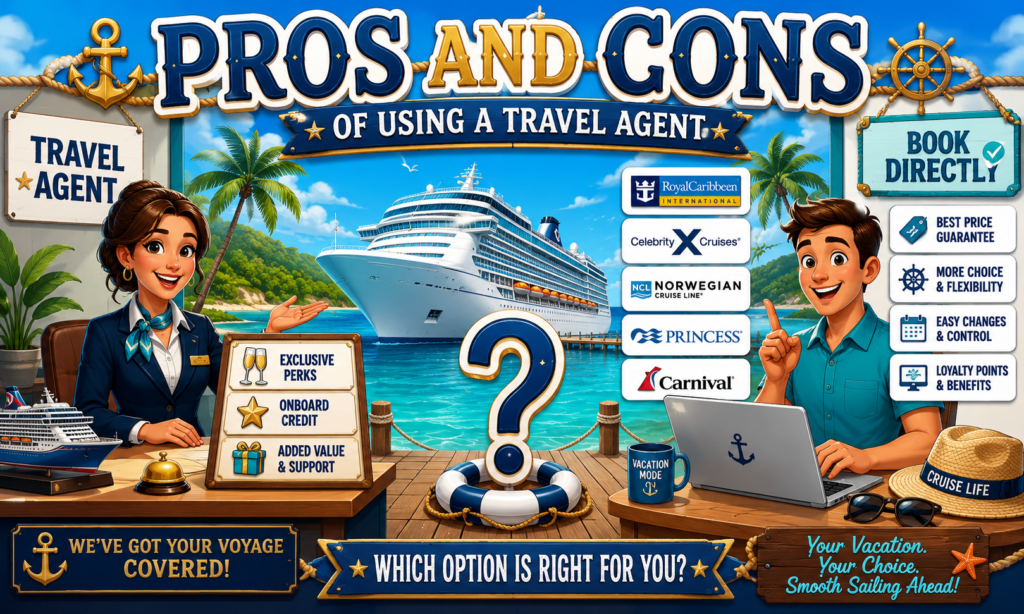
Pros of Using a Travel Agent
Travel Agents Can Save You Time
Cruise planning can often get complicated and become time-consuming. A good travel agent can help with:
-
- Comparing the different cruise lines and helping to find the one that fits your cruising style the best
- Finding the best itineraries that meet your interests
- Selecting the best cabin locations for your budget and preference
- Explaining the various different cruise packages including beverages, WiFi, photos, and dining
- Coordinating all your travel including flights and hotels
- Can handle multiple room or group bookings with ease
-
Instead of spending hours comparing ships and reading reviews, you tell the agent what you want (budget, travel dates, group size, preferences) and they present you with curated options. They can also handle special requests like connecting cabins, dietary needs, or celebrations.
For busy travelers or inexperienced cruisers, the time savings and convenience alone are often worth it.
Travel Agents Often Have Access to Extra Perks and Provide Onboard Credit (OBC)
Many cruise-focused travel agents have partnerships with cruise lines that can unlock extras like below that aren’t available to the general public booking direct:
-
- Onboard Credit (OBC)
- Prepaid / waived gratuities
- Specialty dining packages
- Discounted deposits
- Free upgrades
-
Often the cruise price is the exact same as booking direct — but with the added perks included through the agent providing a better value. Many will also watch your booking and reprice it if the fare drops! That surprises a lot of cruisers.
Travel Agents Know the Small Details
Experienced cruise agents often know things you won’t find clearly explained online. They are often veteran cruisers who have sailed dozens of times on multiple cruise lines and ships. Some agents specialize in only one or two cruise lines that can provide more in-depth expert knowledge before booking. Some of the helpful insight provided may be:
-
- Which cabins have preferred or obstructed views
- Which decks and cabins are noisier (is the dance floor above your cabin?)
- Which ships are best for families, couples, and seniors
- Which itineraries feel rushed vs. a relaxed pace
- When certain ports are overcrowded
-
Those little details can make a huge difference once you’re onboard. An experienced cruise agent may also know about promotions or policies before casual travelers notice them.
Help During Problems or Changes
If flights get canceled, itineraries change, or pricing drops after booking, having a travel agent can be incredibly helpful. Instead of spending hours on hold with a cruise line, your agent may handle:
-
- Handling Logistics During Travel Disruptions (Rebooking, Emergency Interventions, 24/7 Support)
- Navigating Cancellations and Refunds
- Managing “After-Booking” Changes (Price Monitoring, Correcting Errors)
- Resolving Onboard and Excursion Issues (Service Disputes, Third-Party Coordination)
- Reservation issues (Dining, Entertainment)
- Special Needs and Requests (Dietary & Medical, Group Coordination)
-
When travel goes smoothly, this may not seem important. When something goes wrong, it suddenly becomes very important.
Great for First-Time Cruisers
For a first-time cruiser, the sheer volume of choices can be paralyzing. While booking a flight is straightforward, booking a cruise is more like booking a resort, a flight, a restaurant, and a series of tours all at once. A good agent can match you to the “right” vibe as every cruise line has a distinct personality. And every ship can provide a different feel (mega-ship vs. smaller vessels). Not to mention, cruising has its own language:
-
- Embarkation (boarding the ship)
- Tender ports (transported from the cruise ship to shore using smaller boats called tenders)
- Gratuities (per-person per-day tips)
- Drink packages (water, coffee, and tea are included, everything else is pay by the drink or purchase a beverage package)
- Specialty dining (dining with a cover charge)
- Guaranteed cabins (guarantee a stateroom within a specific category, cruise line selects the cabin, as a reduced cost)
-
Booking your cruise can feel overwhelming at first. A good travel agent helps simplify the process and reduces the chance of rookie mistakes.
Cons of Using a Travel Agent
Cruise Proficiency Varies Widely Across the Travel Industry
Some agents are cruise specialists who deliver outstanding service while others are generalists who may push whatever pays them the highest commission or lack deep knowledge in cruising. Choosing the wrong agent may introduce problems. A non-cruise travel agent may:
-
- Recommend poor cabin locations
- Miss the best deals or understand the cruise line’s benefits
- Respond slowly to cruise-specific inquiries
- Give incorrect information
-
To get the most value from a travel agent, invest a little time upfront to find a specialist who truly excels in cruises. Focus on highly recommended agents with deep expertise in the cruise space overall or, even better, strong experience with your specific cruise line and itinerary.
You Lose Direct Control of Your Booking
When booking through a travel agent, you effectively transfer “ownership” of your reservation. While this offers professional oversight, it fundamentally alters how you interact with the cruise line. Once the booking is under an agent’s record, the cruise line’s customer service will typically refuse to modify the reservation directly, directing you back to your agent for nearly every administrative need. This added layer between you and the cruise line can lead to:
-
- Slower response times as you must go through your agent first (not an issue with seasoned agents who are responsive)
- Potential for communication breakdowns as your agent can be the middleman
- Total dependency if your agent becomes unreachable or unresponsive, your concerns will not be addressed
-
Booking with an agent trades direct control for their expertise and (hopefully) better service. This trade-off works well with a responsive, reliable agent — but it can become frustrating if you choose the wrong one. I have used a bad agent before and addressing issues with the booking (wrong name spelling and dates of birth) was a nightmare. That is why using a proven agent is key and not just choosing one based on a $25 savings.
Potential Agent Bias
While many agents are ethical, some may steer you toward certain cruise lines because of preferred partnerships or higher commissions. While this doesn’t automatically mean bad advice, it can influence their recommendations or steer you in an undesired direction. This is why “shopping around” with agents is important (and more time consuming). It is smart to ask:
-
- Which cruise lines do you specialize in, and do you have any preferred partnerships?
- Can you book me on any cruise line I choose, or do you mainly work with a few?
- Have you personally sailed on the ships or itineraries you’re recommending?
- What kind of onboard perks or upgrades can you typically offer compared to booking directly?
- How do you handle changes, cancellations, or problems after the booking is made?
-
By asking these questions upfront, you can quickly identify a transparent, client-focused agent and minimize the risk of bias affecting your cruise plans.
DIY Booking Is Easier Than Ever
We are long past the days of The Love Boat. Websites for the cruise lines are efficient, simple, and available to everyone. If you are an experienced cruiser or know exactly what you want to book, an agent might feel like an unnecessary middleman.
Many travelers now prefer researching everything themselves — comparing itineraries, watching ship tours on YouTube, reading cabin reviews, and booking directly online in just a few clicks. For seasoned cruisers especially, the process can feel straightforward enough that handing control to someone else simply adds an extra layer between you and your vacation.
There’s also the convenience factor. Booking directly gives you immediate access to your reservation, cabin options, dining selections, and upgrade offers without needing to wait for callbacks or emails from an agent. For travelers who enjoy planning and tweaking details themselves, that flexibility can be part of the fun.
At the same time, the rise of online cruise communities has changed how people prepare for trips. Facebook groups, Reddit discussions, cruise forums, and ship walkthrough videos now provide information that once only experienced travel agents were likely to know. A quick search can uncover everything from the quietest cabins onboard to which buffet line moves fastest on embarkation day — because apparently even vacations come with strategy guides now.
My Recommendation
Since I don’t know the specifics of your situation, I’d prefer to share my personal strategy rather than a direct recommendation.
Because most travel agents are paid via commission from the cruise line—meaning their services are essentially free to you—I focus on finding an agent who adds the most value to my booking. My process is to do the heavy lifting first: I research the ship, the specific cabin, and the itinerary I want. Once I have a clear plan, I reach out to reputable agents and high-rated online agencies to compare offers. I’m looking for the best “extras,” whether that’s additional Onboard Credit (OBC), prepaid gratuities, or other perks.
However, this “shopping around” strategy does have its risks. I once booked with a sub-par agent just to save $25, and it turned into a nightmare. When the cruise line made an error, they refused to speak with me directly because the agent “owned” the booking, and that agent was nowhere to be found. I spent hours on the phone frustrated, trying to fix a mess that a professional would have handled in minutes.
I’ve since learned my lesson: I now thoroughly vet agents before booking. I’ve realized that while extra perks are great, a knowledgeable, responsive agent is the real value when things go wrong.
I always wondered if using a travel agent really saves time. Do you think it’s worth the extra cost?
There should be no extra cost. The travel agent receives a commission from the cruise line.