If you are new to cruising, the concept of ship time may be foreign to you, or at least confusing. It is very important to understand what ship time is. For example, you reach your next port of call in the Caribbean, walk off the ship, turn airplane mode off, and see that it’s 10:15 AM. But you just walked off the ship minutes ago, and the ship’s time was 9:10 AM. Which time is right?
That can be a surprisingly important question on a cruise.
When you’re traveling between different time zones, you may encounter different times: ship time and local time. Most of the time, the differences won’t cause any problems. But if you don’t understand which time the ship is using, you could end up missing a reservation, showing up at the wrong time for an excursion, or, in the worst case, missing the ship at the end of the day.
Here’s why understanding ship time matters.
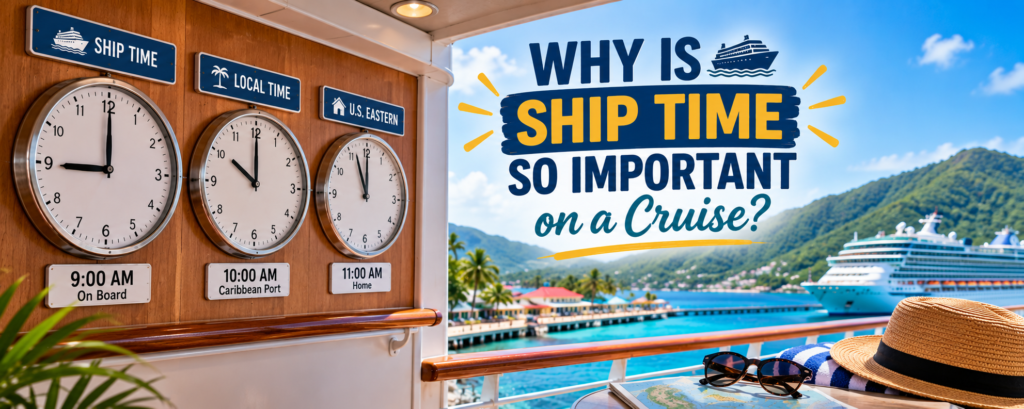
Ship Time vs. Local Time
Ship time is the official time being used aboard the ship. It’s the time the cruise line wants you to follow for things such as dining reservations, entertainment, onboard activities, and, most importantly, the time you need to be back on the ship.
Local time is the time being used in the destination where the ship is currently located. Once you walk off the ship, local businesses, restaurants, taxis, attractions, and other services will generally operate according to local time.
These two times can be the same, but often they are not.
Your phone can make this even more confusing. Depending on your settings, Wi-Fi network, or cellular connection, your phone may automatically adjust to the local time when you arrive in port. You could step off the ship with your phone showing a different time than the clocks aboard the ship.
That doesn’t necessarily mean the ship changed its time. It just means your phone updated to local time. This is why you should pay attention to the time the cruise line tells you to follow rather than simply assuming your phone is correct.
How Can You Miss the Ship?
This is the most important reason to understand ship time. Imagine your ship tells you that all passengers need to be back onboard by 4:30 PM ship time. You get off the ship and your phone changes to local time, which happens to be an hour behind ship time. You spend the afternoon shopping, having lunch, and exploring. You check your phone and see 3:15 PM, so you think you have plenty of time. But according to the ship, it’s actually 4:15 PM.
You start making your way back to the port. It’s a 25-minute walk, and you arrive only to see your ship sailing away to the next port. The captain stated that all-aboard time was 4:30 PM. You look at your phone and it shows 3:40 PM. You think you have 50 minutes before all-aboard time. But the ship isn’t running on local time. It is already 4:40 PM ship time, which means you have already missed the 4:30 PM all-aboard deadline.
Cruise lines make it clear that passengers are responsible for being back onboard on time. If you miss the ship while exploring independently, getting to the next port is your responsibility. Ships will do what they can to allow guests to return, but other factors, like the port schedule or the time it takes to get to the next port, may require the captain to depart on schedule, leaving you behind.
If the ship leaves without you, you will find yourself talking to a port agent as they explain your options for meeting the cruise at the next port, all at your expense. Remember this simple rule: When you’re in port, follow the ship’s instructions about what time you need to be back onboard.
Not Every Cruise Ship Handles Time Zones the Same Way
This is where things get a little more complicated. There isn’t one universal rule that every cruise line follows when traveling through multiple time zones. Some ships will adjust ship time as they travel into a new time zone. When that happens, the cruise line will generally let passengers know ahead of time so they can adjust their watches and plans. Other ships may maintain the same ship time for some or all of an itinerary, even when the local time ashore is different.
The practice can vary depending on the cruise line, ship, itinerary, and voyage. So don’t assume that the ship will automatically change its clocks every time it enters a new time zone. And don’t assume the opposite, either.
The ship will tell you when a time change is taking place.
On one Western Caribbean itinerary with Princess that my wife and I took a couple of years ago, the ship adjusted the ship time whenever it crossed into a new time zone. There were announcements and a letter left in our cabin to inform us that the ship’s time would adjust overnight. We changed times four of the seven days on that cruise, which we found highly annoying. For that cruise, we wished the ship had remained on a constant ship time.
Pay attention to announcements, the daily schedule, your cruise app, messages in your cabin, and any other information provided by the cruise line. Knowing ship time is critical to ensuring your vacation runs smoothly.
Your Phone Isn’t Always the Time You Should Follow
Smartphones are great at automatically adjusting to local time. That’s normally a helpful feature. On a cruise, however, it can create some confusion. You might wake up and see that your phone has changed overnight. You might step off the ship and notice that the time has changed again. If you aren’t paying attention, it’s easy to assume that the ship is operating on the same time.
That’s why I don’t rely solely on my phone when I’m cruising. Before leaving the ship, you need to be able to tell both ship time and local time. Ship time is the most critical because the worst-case scenario is missing the ship.
That is why I will force my phone’s time zone to ship time. I then have to remember the difference between ship time and local time. If local time is one hour behind, I will have to subtract that from my phone’s time to know the current local time.
Knowing local time is important if you have any reservations or excursions that day in port. It is not as important if you are just having a free day at the beach or walking around town. Just make sure you know the ship time for that all-important all-aboard deadline.
The Bottom Line
Ship time may seem like a small detail, but it’s one of those things that becomes important when you least expect it. Most port days won’t involve any confusion at all. But when ship time and local time are different, you need to pay attention so you don’t lose track of the actual all-aboard time.